From the Museum
The Konark Wheel: How a 13th-Century Chariot Became an Icon
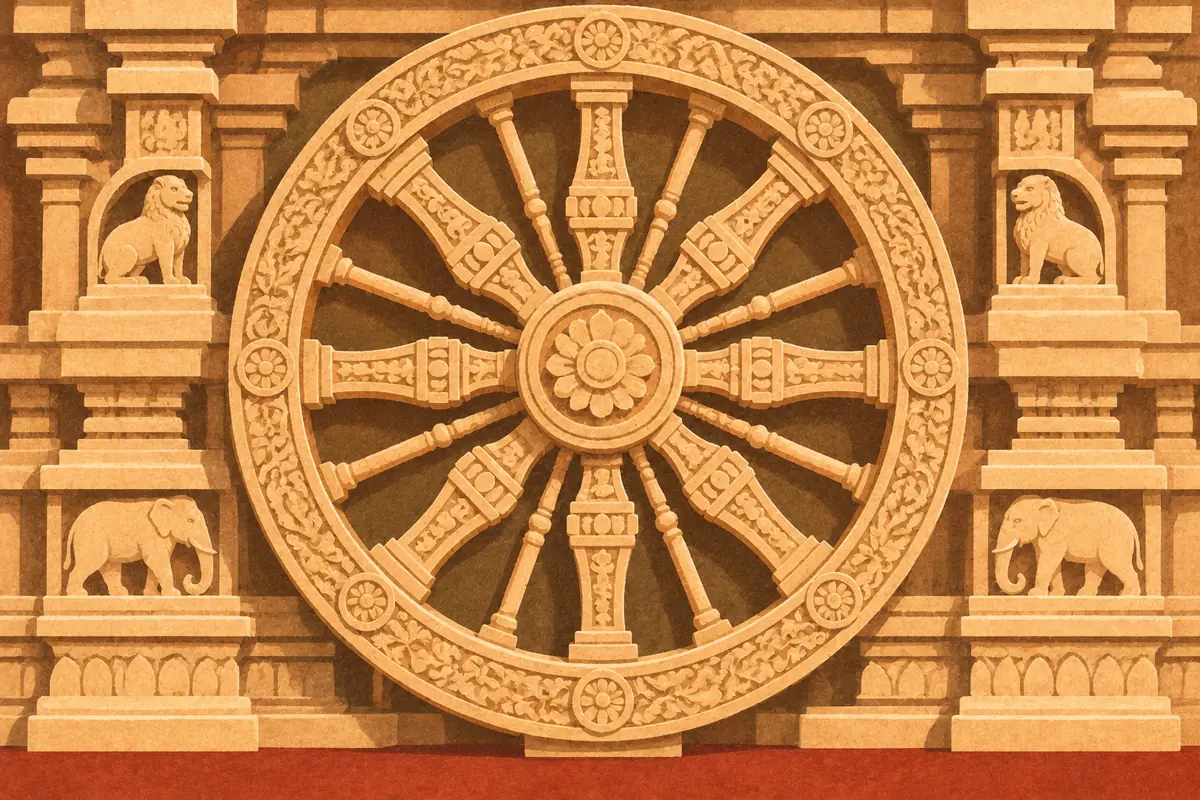
If you have seen one image of Odisha, it is probably this: a huge stone wheel, taller than a person, covered in carving. It belongs to the Sun Temple at Konark, and it has become one of the most recognised designs in India.
A temple built as a chariot
The Sun Temple was built in the 13th century, around 1250 CE, by King Narasimhadeva I of the Eastern Ganga dynasty. It was dedicated to Surya, the sun god, who in Indian tradition rides across the sky in a chariot. So the builders made the temple itself into that chariot.
- Its base carries 24 carved stone wheels, twelve on each side.
- Stone horses are shown pulling it. Tradition says seven.
- Each wheel is about three metres across.
The main tower has long since collapsed, but the hall in front of it and the wheels along its base still stand. The temple was declared a UNESCO World Heritage Site in 1984, and it appears on the back of India’s ₹10 note issued from 2018.
How to read a Konark wheel
- Eight thick spokes and eight thin spokes alternate around the hub.
- The hub and the centres of the thick spokes carry round medallions, filled with carved figures and foliage.
- The rim is decorated with a running band of creepers and small beads.
The wheels are often described as sundials: guides at Konark show visitors how the shadow of a spoke falls across the rim to tell the time. Whether they were designed for that or the idea grew later, it is a good story, and it fits a temple to the sun.
Why the wheel speaks to so many people
The wheel, or chakra, is one of the oldest symbols in India. It stands for time, movement, the turning of seasons, and, in Buddhist art, the teaching of the Buddha. The Ashoka Chakra at the centre of India’s flag is a 24-spoke wheel taken from a Mauryan capital. A Konark-style wheel on your wall carries all of that without saying a word.
Using a wheel in your home
- A large wheel works as a single statement piece on a big empty wall: a living room, a stairwell or an office reception.
- Hang it with the centre at eye level so the spokes radiate around you.
- Wood tones with a red rim and gold details echo the warm sandstone of the original.
The “Black Pagoda”
European sailors in the Bay of Bengal used the dark tower of Konark as a landmark and called it the Black Pagoda, to tell it apart from the whitewashed Jagannath temple at Puri, the White Pagoda. The main tower collapsed long ago. In 1903, to stop the remaining hall (the jagamohana) from falling, it was filled with sand and sealed. Conservation work on it has continued in recent years.
What the carvings show
Konark is covered in sculpture. The wheels alone carry hundreds of small carved panels: women at their toilette, musicians, hunters, animals, and scenes from court and daily life. Around the walls are dancers, elephants and mythical beasts. Above them stand large images of Surya. A line often attributed to Rabindranath Tagore sums up the effect: here the language of stone surpasses the language of man.
Visiting Konark
- Konark is on the coast of Odisha, about 35 km from Puri and 65 km from Bhubaneswar.
- Go early in the morning, when the low sun picks out the carving and the crowds are thin.
- The ASI museum next to the temple holds many fallen sculptures you can see up close.
- The Konark Dance Festival, held each December against the temple, brings classical dancers from across India.
Wheels across Indian art
Konark is the most famous, but carved wheels appear in many places: the stone chariot at the Vittala temple in Hampi, the wheels on temple chariots that are pulled through the streets during festivals such as the Rath Yatra in Puri, and the dharma wheel at Sarnath and Sanchi. Each carries the same idea of movement, time and order.
Questions people ask
How many wheels does Konark have?
Twenty-four, arranged in twelve pairs along the base of the temple.
Is the Konark wheel the same as the Ashoka Chakra?
No. The Ashoka Chakra on the national flag has 24 equal spokes and comes from a Mauryan pillar capital at Sarnath. A Konark wheel has eight thick and eight thin spokes and comes from a 13th-century temple.
From our workshop
Our Chakra Wheel is a 440 mm wall piece with eight thick and eight thin spokes in teak, a red oxide rim and gold rosettes, after the great wheels of Konark. It is an original design, cut and finished by hand in Mumbai. See it in the Ukera Museum.