From the Museum
The Hamsa and the Lotus: Two Symbols Carved Across Indian History
Some images turn up again and again in Indian art, across religions and across two thousand years of history. Two of the most loved are a bird and a flower: the hamsa and the lotus.
The hamsa: the bird of wisdom
The hamsa is usually translated as goose or swan. In Indian texts it is a bird of purity and discernment. A popular image says the hamsa can separate milk from water when the two are mixed, which made it a symbol of wisdom: the ability to tell the true from the false. The bird is also the vehicle of Saraswati, goddess of learning, and of Brahma.
Where to find it
- Mauryan pillars: some of the capitals on Mauryan pillars, the tall polished columns associated with Emperor Ashoka, have a band of geese carved around them.
- Buddhist monuments: rows of geese appear on stupa railings and in the paintings at Ajanta.
- Temples: across India, temple plinths and doorframes often carry a frieze of hamsas marching in a line, sometimes holding lotus stems in their beaks.
- Textiles: the hamsa border is a favourite on saris and woven cloth to this day.
The lotus: rising clean from the mud
The lotus grows in muddy water yet opens clean and bright, so it became a symbol of purity, beauty and spiritual awakening. It is the seat of many deities, it is associated with Lakshmi, goddess of prosperity, and it is India’s national flower.
Where to find it
- Temple ceilings: carved lotus medallions, often in several layers of petals, fill the ceilings of temple halls from Odisha to Karnataka.
- Ajanta: painted ceiling panels in the caves are full of lotus rosettes and scrolling lotus stems.
- Buddhist railings: at Bharhut and Sanchi, half-lotus and full-lotus medallions decorate the railing posts.
Why the pair belongs together
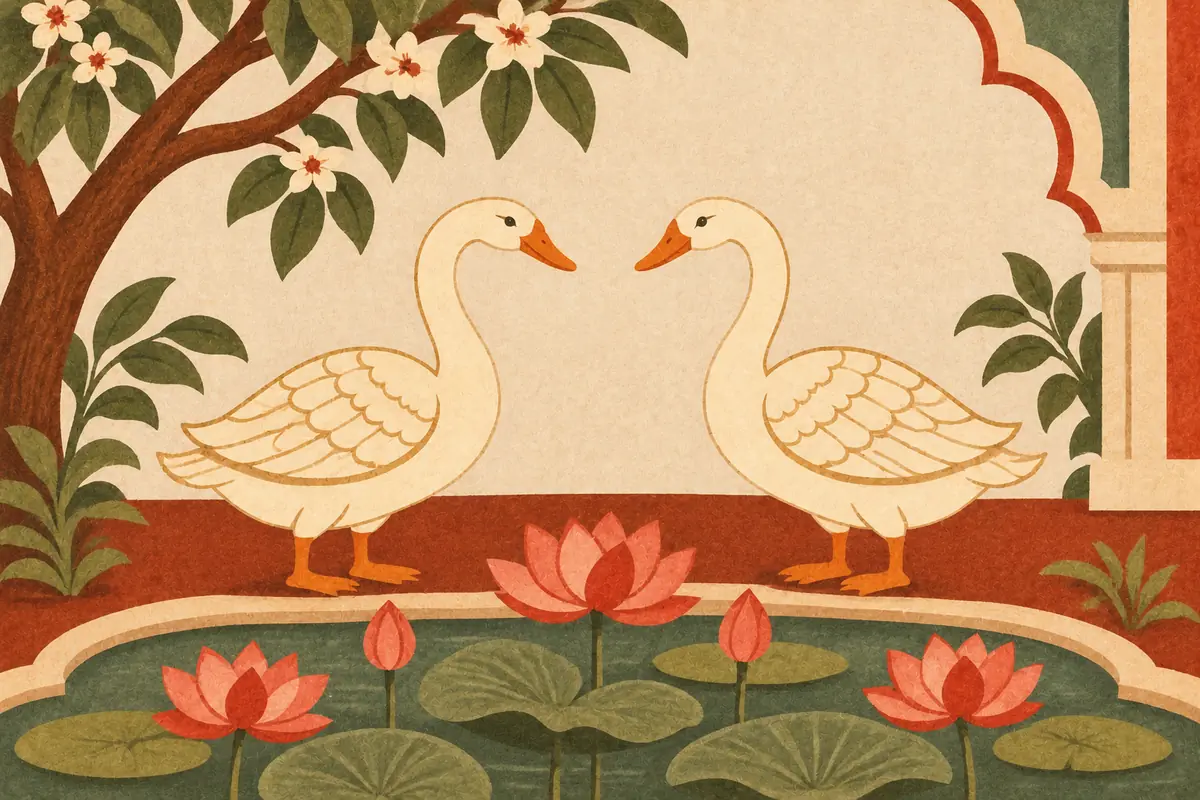
The hamsa is a water bird and the lotus is a water flower, so they often appear together: two geese facing a lotus, or a goose holding a stem in its beak. Together they suggest a calm, pure, well-ordered world, which is a good wish to hang in a home.
Using these symbols in decor
- A lotus medallion works as a round centrepiece above a bed, a sofa or a pooja corner.
- A hamsa frieze suits a horizontal space: a nameplate, a headboard wall or above a doorway.
- Keep colours simple. Red, gold and wood tones echo temple carving and painted ceilings.
The hamsa in stories
The hamsa appears in many Indian stories. In the Jatakas, the tales of the Buddha’s previous lives, the Bodhisattva is sometimes born as a golden goose, a wise and generous king of the geese. The Hamsa Jataka is among the stories painted on the walls at Ajanta. In the Mahabharata, a hamsa carries messages between Nala and Damayanti, which made the bird a symbol of love and loyalty as well as wisdom.
The lotus in stories and worship
- In Hindu tradition, Brahma, the creator, is born on a lotus that grows from the navel of Vishnu.
- Lakshmi, goddess of prosperity, stands or sits on a lotus and holds lotuses in her hands.
- In Buddhist art, the Buddha is often shown seated on a lotus, and the flower stands for a mind that rises above the world without being stained by it.
- In Jain art, lotuses decorate temple ceilings and the halos of the Tirthankaras.
How carvers draw a lotus
When an Indian sculptor carves a lotus seen from above, it usually follows a set pattern: a round seed pod in the centre, a ring of short inner petals, and one or two rings of longer outer petals, each with a ridge down the middle. Larger medallions add bands of beads or creepers around the outside. Once you know the pattern, you will spot it on temple ceilings, pillars and railings everywhere.
A modern lotus
The lotus still shapes Indian design today. The Bahá’í House of Worship in Delhi, completed in 1986 and known as the Lotus Temple, is built as 27 white marble-clad petals. It is one of the most visited buildings in India.
Where to place these symbols at home
- Entrance: a hamsa nameplate or a lotus motif at the door says welcome.
- Living room: a large lotus medallion makes a calm focal point.
- Pooja corner: a lotus is a natural fit.
- Study: the hamsa, linked with Saraswati and learning, suits a reading or work space.
Questions people ask
Is the hamsa a swan or a goose?
Both translations are used. In early Indian art the bird usually looks like a bar-headed goose, which migrates over the Himalayas. Later, “swan” became a common translation.
Is the hamsa the same as the hamsa hand?
No. The hamsa hand is a palm-shaped amulet from West Asia and North Africa. The Indian hamsa is a bird.
From our workshop
Our Mandir collection includes the Kamal Medallion (a four-layer lotus), the Hamsa Pair (two geese facing a lotus), the Kamal Trio (a lotus as bud, half open and in full bloom) and the Hamsa Nameplate, with a row of gold geese under your name. All are original designs. See the art behind them in the Ukera Museum.