From the Museum
Charminar and the Qutb Shahi Domes: Reading Hyderabad’s Skyline
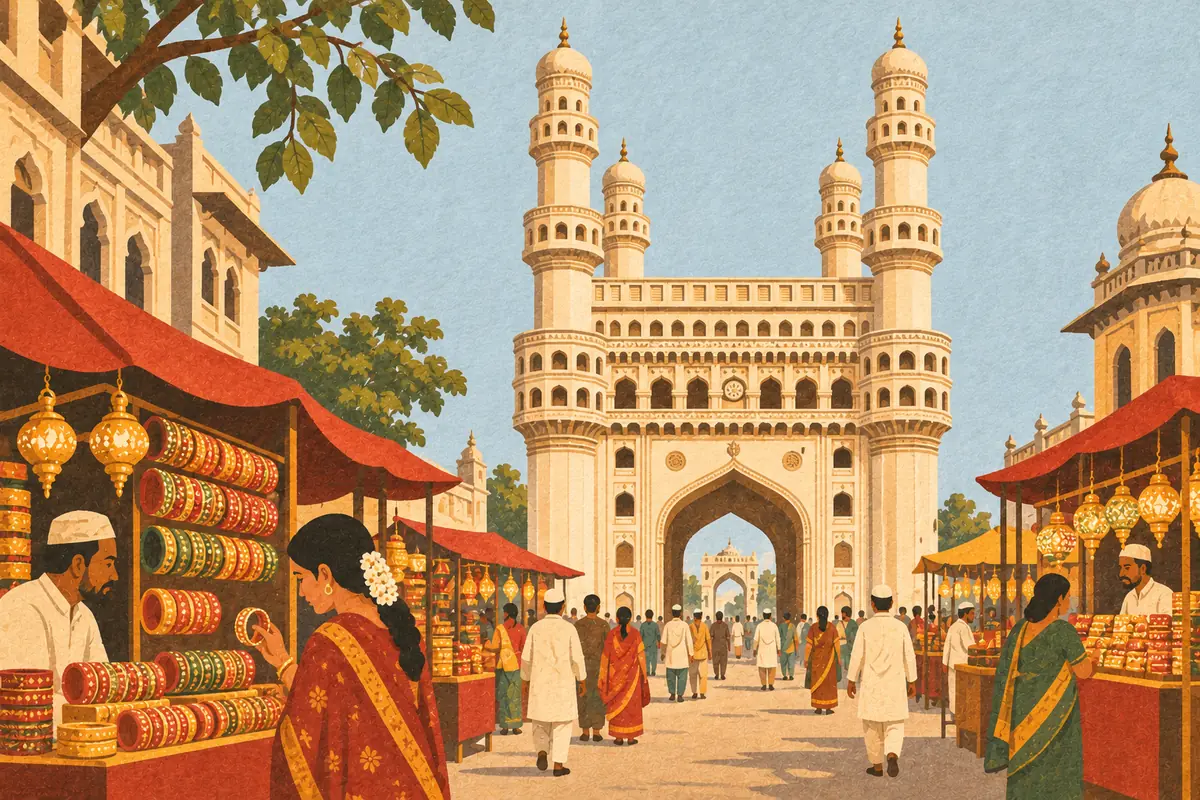
Hyderabad has a skyline that belongs to no other city: four slender minarets around a great square arch in the old city, and, a few kilometres away, a field of huge onion-shaped domes rising out of a garden. Both come from the Qutb Shahi dynasty, which ruled the Golconda kingdom in the Deccan for nearly two centuries.
The Qutb Shahis and Golconda
The Qutb Shahi dynasty ruled from Golconda from the early 16th century until 1687, when the Mughal emperor Aurangzeb conquered the kingdom. Golconda was famous for its fortress and for diamonds: some of the world’s most famous stones are said to have come from mines in the region and passed through its markets.
The rulers were great builders and patrons of poetry, music and craft. They created a style now called Deccani: Persian in its arches and domes, Indian in its craftsmanship and ornament.
The Charminar
In 1591, Sultan Muhammad Quli Qutb Shah built the Charminar (“four minarets”) at the heart of his new city, Hyderabad. It became the city’s centrepiece and remains its best-known landmark.
- It is a square structure with a great arch on each of its four sides, each facing a main street.
- A minaret rises at each corner, with balconies at each level and a small dome on top.
- The upper storeys hold galleries of small arches, and there is a mosque on the top floor.
- The surfaces are covered in fine stucco ornament: flowers, petals and geometric bands.
Today the streets around it, with the bangle shops of Laad Bazaar, the pearl sellers and the food stalls, are as much a part of the experience as the monument itself.
The Qutb Shahi tombs
Near Golconda Fort lies the royal necropolis of the Qutb Shahi kings: a garden of tombs, mosques and stepwells. The great tombs stand on raised platforms, ringed by arcades, and are crowned with tall, bulbous domes that rise from rings of carved petals. Some were once covered in coloured glazed tiles.
After years of decay, the complex has gone through a long restoration led by the Aga Khan Trust for Culture with the Telangana government, uncovering original tilework and plaster. It is one of the most impressive heritage restorations in India and well worth a visit.
How to read Deccani architecture
- Pointed arches: drawn from two circles, giving a gentle point at the top.
- Bulbous domes: fuller and rounder than Mughal domes, often sitting on a band of lotus petals.
- Minarets: tall and slender, ringed with balconies.
- Stucco: fine plaster ornament of flowers, vines and geometry.
- Gardens and water: tombs and palaces set in walled gardens with tanks and stepwells.
Bringing Deccani style home
- A pointed-arch shape suits a nameplate or a mirror frame.
- Ivory and red echo the old lime plaster and painted walls of the Deccan.
- Domes and minarets make a striking silhouette for a large wall piece.
Questions people ask
When was the Charminar built?
In 1591, by Sultan Muhammad Quli Qutb Shah, the founder of Hyderabad.
Can you go inside the Charminar?
Visitors can usually climb to the first-floor gallery. Opening hours and access to upper floors can change, so check before you go.
More Deccan architecture to see
- Golconda Fort, Hyderabad: the hilltop fortress of the Qutb Shahis. Guides like to show how a clap at the entrance can be heard high up on the hill.
- Mecca Masjid, Hyderabad: one of the largest mosques in India, a short walk from the Charminar.
- Gol Gumbaz, Vijayapura (Bijapur): the 17th-century tomb of the Adil Shahi sultan Muhammad Adil Shah, with one of the largest domes in the world and a famous whispering gallery.
- Bidar Fort and the Mahmud Gawan Madrasa, Bidar: 15th-century buildings from the Bahmani era, with remains of coloured tilework.
The Deccan’s mix of cultures
The Deccan sultanates were meeting points. Persian, Turkish, Arab, African and local Telugu, Kannada and Marathi cultures all met at their courts. You can see it in the buildings: Persian arches and domes, Hindu temple brackets and lotus motifs, and local stone and plaster craft, all in one structure. Dakhni, the language that grew up in the region, mixes Urdu with local words in the same way.
From our workshop
Our Dakhni collection draws on this architecture: the Charminar Nameplate with its great arch and two minarets, the Golconda Nameplate crowned with a petal-ringed dome, the Dakhni Mehrab Nameplate with a pointed Deccani arch, and the Charminar Panel wall art. Each nameplate can carry your name in English with Urdu or Telugu. See them in the Ukera Museum.