Guides
How to Choose the Right Nameplate for Your Home
A nameplate is small, but it is the first thing every guest, courier and neighbour sees. A good one makes a home feel cared for before the door even opens. Here is how to choose one that fits your door, your family and your budget.
1. Measure your door first
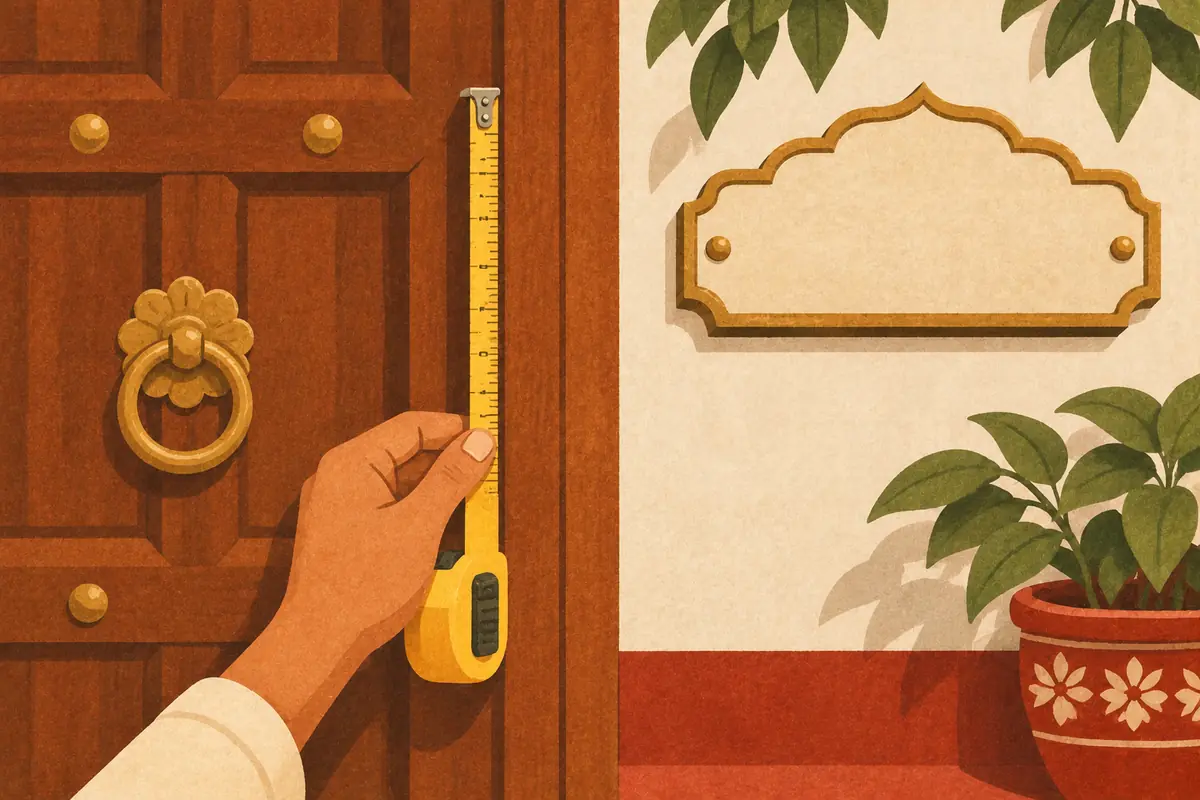
Most flat doors in Indian apartments are around 900 mm to 1,000 mm (3 to 3.3 ft) wide. Measure the flat area where the plate will go, then leave some space around it.
| Where it goes | Good size |
|---|---|
| Flat door, centred | About 250 to 300 mm wide (10 to 12 in) |
| Wall beside a flat door | About 300 to 360 mm wide (12 to 14 in) |
| Bungalow gate or pillar | About 400 to 600 mm wide (16 to 24 in) |
| Office or clinic | About 450 to 600 mm wide, with large, simple lettering |
A rule of thumb: the plate should take up no more than about a third of the door width. Bigger than that and it starts to look like a signboard.
2. Decide what it should say
- Surname only (“Iyer”) is clean and works at any size.
- “The [Surname]s” (“The Kulkarnis”) feels warm and modern.
- First names and surname (“Anjali & Rohan Mehta”) is personal and popular for couples.
- Flat or house number: add it as a second, smaller line. Couriers will thank you.
- A blessing or house name: “Shubh Griha”, “Shubh Labh” or a house name like “Casa Rosa” adds character.
Keep it short. Two lines are ideal. Three is the maximum for a flat door.
3. English, Hindi or both?
Bilingual nameplates are increasingly popular: the surname in English on one line and in Devanagari (or your own script) below it. It looks good, it honours the family’s language, and it helps visitors of every generation. Check the spelling in both scripts with an elder before you approve the design.
4. Choose a material
- Acrylic: light, waterproof, crisp and available in many colours, including mirror finishes. Good for most doors.
- Wood or wood-finish: warm and traditional. Best on doors protected from direct rain.
- Layered (wood or acrylic base with gold mirror letters): gives depth and a premium look, with shadows that change through the day.
We compare materials in detail in our guide to acrylic vs wood nameplates.
5. Pick a style that matches the house
- Modern flat: a clean rectangle or square in black, white or sage, with simple lettering.
- Traditional home: wood with gold, or a motif with history: a temple doorway, a jaali window, a lotus.
- Bungalow: a larger plate with a strong shape, like an arch or a gateway, that reads from the gate.
6. Readability
- Choose a font that is easy to read from 2 to 3 metres away. Very thin script fonts look lovely close up but disappear from a distance.
- Make sure there is strong contrast: gold on dark wood or black, dark letters on ivory.
- Main lettering should be at least 25 to 30 mm tall on a flat door.
7. Where to fix it
- At about eye level, roughly 1.5 m (5 ft) from the floor to the centre of the plate.
- Centred on the door, or on the wall on the handle side, so it is seen as the door opens.
- Steel standoff caps give a floating look. Strong double-sided mounting tape works on smooth doors where you do not want to drill.
8. Always ask for a proof
Before anything is cut, ask the maker for a drawing with your exact names, spelling and layout. Check it on your phone at full size. Changing a letter costs nothing on screen and a lot after cutting.
Common mistakes to avoid
- Too much text. Names, flat number, house name, a blessing and a phone number on one plate is too much. Pick two or three.
- Thin fonts on a dark door. Delicate letters vanish from a few steps away. Choose bolder letters, or bigger ones.
- Wrong size for the door. Always measure. A plate that looked right on a phone screen can look tiny, or huge, on the door.
- Ignoring the society rules. Some housing societies ask for a standard size or position for flat number plates. Check before you order.
- Not checking the spelling. Spellings of surnames vary across families and regions. Confirm before you approve.
Nameplates for rented homes
If you rent, you may not want to drill into the door. Strong double-sided mounting tape holds a light acrylic nameplate firmly on a smooth, clean door and can be removed when you move. Clean the door with a dry cloth first, press the plate firmly for 30 seconds, and avoid fixing it in very humid weather.
Nameplates for offices, clinics and shops
- Lead with the name people search for: the clinic name or the doctor’s name, not both at the same size.
- Add qualifications or the type of business on a smaller second line.
- Choose clean, high-contrast lettering that can be read from the corridor or the road.
- A brand colour on the base, with the logo cut in, looks far more professional than a printed sticker.
A note on Vastu
Many families like to follow Vastu guidance for the entrance, for example on colours or where to place the nameplate. Practices vary, so if this matters to your family, ask whoever you usually consult and share their advice with the maker. A good maker will happily adjust colours and layout.
Questions people ask
How long does a custom nameplate take?
Making usually takes a few days after you approve the proof. Add shipping time for your city.
Can I put a nameplate outside, on a gate?
Yes, but choose weather-resistant materials such as acrylic, and avoid wood-finish board where rain hits it directly.
Should the nameplate match the door colour?
It should contrast with it. A dark plate on a light door, or a light plate on a dark door, is easiest to read.
Ready to design yours?
Every Ukera nameplate comes with a free proof on WhatsApp before we cut. Browse heritage designs inspired by Indian art, or our simple Everyday range, and send us your names.